Quick Links

Showing posts with label Animal Husbandry. Show all posts

Wednesday, May 11, 2016

Tellachery goats for sale!

We are happy to announce that we completed 1 year of goat ops last week. It has been an incredible journey so far, with a lot of lessons learned along the way.  In the next few weeks, we will elaborate more on our learnings with commentary on practice vs theory of goat operations.

In the meanwhile, we have about 40 Tellacherry goats, ranging from 6 months to 1.5 years for sale. Kindly contact us if you are setting up a new farm or have a requirement for live goat. We are giving great pedigree animals, with documented vaccinations, well fed and maintained.

Call 91 94450 76595


Friday, March 7, 2014

Fresh Fodder Development : Importance, Constraints and Options

At Savera Farms, we have now been raising our Goat herd to close to a year now. Apart from capital intensive expenses like the shed, it soon became clear that most of our resources will be spent on procuring and preparing the daily feed. This experience seems to be universal to most animal husbandry practices, including dairy and meat production. It is estimated that no less than 70 per cent of the cost of milk production in India goes towards fodder and yet fresh feed remains woefully deficient in quality in India.

Adopting balanced feed-rations and breeding animals with higher “feed-conversion efficiency” seems to have become critical in increasing their productive life, reducing the incidence of disease, and lowering the cost of production. In India, livestock is largely fed on agricultural residue and straw-based fodder which were deficient in several nutrients. While green fodder is more nutritious, only 10 per cent of the area under green fodder is sown with certified seeds. As the demand for milk products and meat rise in India, agri operations will have no choice but to increase fodder yield and productivity.

Among high yield techniques there are very few which surpass the efficiency of Hydroponics. While Hydroponics has been a widely discussed topic in online forums, very few operators have adopted this in a significant way. Savera Farms has flirted with the idea but we have not committed serious effort behind this yet. Not withstanding the high capital investment, there is still a lack of competent and widely available expertise in India. This has been a constraint for a while but with initiatives like PetBaro, there is increased awareness in urban locations. We are hoping, over time such knowledge building initiatives will help with increased adoption of Hydroponic practices. There was an interesting commentary online around the constraints of Hydroponics in the Indian landscape.


Listed below are a few pioneers and solution providers in the Hyroponic space in India. We share this with our readers so they can seek inspiration, benefit from current innovations and yet make informed decisions. Do share your experiences, favorable or cautionary, with the community for better decision making.
  •     AgroVision
  •     GrassFodder Hydroponics
  •     Greentech Hydroponics
Disclaimer : We do not endorse or have used the above service providers. Readers should be diligent while determining their Hydroponic strategies.

Sunday, February 23, 2014

Savera Farms Goat Operations - 6 months hence


Massaging my mommy

Savera Farms got into Animal husbandry last July with a couple of dozen Tellacherry and Kanni goats. So far we have had a good run with as many births and a couple more bulk purchases. In a few months, our herd was over 100 strong. Entry into animal husbandry was a strategic decision to minimize the risk from our land crops (Mango & Moringa) and capture the opportunity of increased meat consumption. We have not limited ourselves to just the meat segment but are breeding pureline Tellacherry goats as well. In another a couple of months, we should be ready with our first batch of kids for sale.


Blue eyed buck!

Tertiary benefits include collection of manure. During our initial analysis, manure volumes were marginal at best. Over the months, we have developed ways to increase our manure. Fresh manure is briefly dried and mixed with urine soaked soil. Later this mixture is moved to a compost pit for curing. Over the past 4 months, we have been able to fill 2 pits. Into this pit we also add other organic matter such as Moringa waste. Each pit should produce about 40-50 tractor loads of enriched soil and manure in about 4 months.


King of the cell

At Savera Farms, we hope to be able to introduce artificial insemination (AI) in the near future. There has been a lot of research done in this field in recent years. Bovine AI has been particularly successful while small ruminant AI has seen successfully pregnancy rates of up to 25-30%. Govt. of Kerela is spearheading field trials in this space in India using Tellacherry goats. While current techniques provide lower pregnancy rates, AI can be useful for cross breeding and to prevent issues related to inbreed of animals. 


Sibling love!

Goats at our farm are given nutritious and diverse feed ranging from CO4, Agathi, Subabul, Tamarind leaves, Neem leaves, Azolla, Bajra and Maize fodder, in addition to concentrate feed. They are dewormed every 3 months and have been vaccinated with PPR and ETV. If any of you are planning to start a new farm, we would be happy to provide mature breeding animals with prior kidding history and practical advice, invaluable for a new operation!

Wednesday, January 29, 2014

Azolla Cultivation 101

To supplement our growing fodder needs, we have been busy developing alternate (and hopefully cheaper!) sources. Once such alternative on our list was Azolla. Due to competing priorities, Savera Farms Azolla initiative had been on the back-burner but recently we have begun our Azolla trials. 

For those who may not be familiar, Azolla is a great source of protein and we are hoping to reduce a significant portion of concentration mix once our initial attempts are successful. It is quite easy to cultivate and one does not need many resources to get started. Supposedly, it is rich in proteins, essential amino acids, vitamins and several key minerals. On a dry weight basis it contains 25 - 35 percent protein, 10 - 15 percent minerals and 7 - 10 percent of amino acids.

During our trials :
  • 10-15 kg of sieved soil was uniformly spread over the Silpauline pit.
  • Slurry was made of 2 kg cow dung and 30 g of Super Phosphate mixed in about 10 L of water. This was poured onto the sheet and additional water was added to raise the level to 10 cm. 
  • About 0.5-1kg of mother azolla culture seed material was spread uniformly over the water. After a mild stirring of soil and water, the Azolla bed was allowed to settle.
 
Sieved soil with cow dung slurry 
  • Fresh water was sprinkled over the Azolla immediately after inoculation to make the plants upright.  
  • In about 5 days, sprouted Azolla had started to spreads across the bed. In the coming days, this is expected to develop into a thick mat.
 

                                                                    Azolla in Silpaulin pit

  •  Per our instructions, a mixture of 20 g of Super Phosphate and about 1 kg of cow dung will be added once in 5 days in order to maintain rapid multiplication and encourage a daily yield of 500 gms.
  • About 5 kg of bed soil will be replaced with fresh soil, once in 30 days to avoid nitrogen buildup. Periodically, fresh water will be replenished as well. 
  • Mature Azolla beds are expected to yield upto  25-40 tonnes of dry matter per hectare. Their rapid, thick development is represented in this staged visual.


There is a lot of research being done on Azolla and it has proved itself to be a legitimate source for fodder supplement and even biomass for renewable fuel production. In India, several organizations like Natural Resources Development Project (NARDEP) have been spearheading the use of Azolla for rural applications. Here are a few tips from them :
  • It is important to keep Azolla at the rapid multiplication growth phase with the minimum doubling time. Therefore biomass (around 200 g per square meter) should be removed every day or on alternate days to avoid overcrowding.
  • The temperature should be kept below 25°C. If the temperature goes up the light intensity should be reduced by providing shade. If possible, it is best to place the production unit where it is shady.
  • The pH should be tested periodically and should be maintained between 5.5 and 7.
  • The Azolla bed should be cleaned, the water and soil replaced and new Azolla inoculated once every six months.
  • Wash the Azolla to get rid of the cow dung smell. Washing also helps in separating the small plants which drain out of the tray. The plants along with water in the bucket can be poured back into the original bed. 
  • For use as a livestock feed, the fresh Azolla should be mixed with commercial feed in 1:1 ratio to feed livestock. After a fortnight of feeding on Azolla mixed with concentrate, livestock may be fed with Azolla without added concentrate.


This was an interesting video we found online touting the overall potential and opportunities with Azolla. Hopefully this will spur a few of you onto an entrepreneurial track!

Credits : http://www.vknardep.org/

Monday, December 9, 2013

Fodder Security : Maize Cultivation

At Savera Farms, we currently produce a large part of our fresh fodder needs for our goat operations. However, there are additional ingredients in the goat feed which are critical as well. In general, goats require energy, protein, vitamins, minerals, fiber (bulk) and water. In our case, of meat goats, calorie intake is an important and usually the most limiting nutrient. For meat production, goats have to be able to gain lean fat. Similarly, any deficiencies, excesses and imbalances of vitamins and minerals can limit animal growth, lead to health problems and result in wasteful feeding expenses.

Multiple factors affect nutritional requirements of goats: maintenance, growth, pregnancy, lactation, fiber production, activity and environment. As a general rule of thumb, goats consume at least 3% of their body weight in dry matter feed. The exact percentage varies according to the size (weight) of the goat, with younger animals needing a higher percentage intake during the growth phase. Environmental conditions also affect maintenance requirements. During cooler (or wet) months, we noticed that goats require more feed to maintain body heat. The added stresses of pregnancy, lactation and growth further increase nutrient requirements as well.

Keeping in mind our growing demand for quality goat feed, we planted a few acres of Maize in hopes of reducing per unit feeding cost. The crop has been in the ground for a few weeks and has started to show signs of life. Gap filling was performed after 15 days of initial sowing. Estimated germination rate is about 80% based on the seed dispersal method used. Given we have no prior experience with Maize, we are eager to see how this crop performs.


We are drip irrigating the crop twice a week for about 45 min. To further minimize cultivation cost, we are not using any fertilizers. Flyash was used in small quantities during soil preparation and it seems that it was a wise choice.


We expect our goat feed demands to continue rising as our initial herd has now stabilized and we plan to continue growing it in size. Current suppliers of goat feed or ingredients like Maize (powder form) can reach out if interested in working with us. Partnering with experienced producers allows us to focus on our core activities and we can outsource other tasks for additional job / employment opportunities in an already stressed industry.

Monday, November 18, 2013

In the news : Supply Shortage for Meat Animals

Savera Farms started their goat operations earlier this year but we have been studying the domestic meat market for close to 2 years now. Despite several non-vegetarians each of us may personally know of, meat consumption in India is among the lowest in the world. Several studies have shown meat consumption in India being traditionally low but despite our historical & cultural preferences, there is a distinct change in tide with rise in per capita consumption. Rise in demand can be largely attributed to changing lifestyles, better product availability and affordability.


Despite the low(er) nationwide demand, meat consumption is no longer only for the upper echelons of society. The prices remain high in parts of the country depending on the type of meat. It may be easy to assume that prices are purely driven by demand & supply but as seen even in developed countries, meat production is among the most expensive across all types of food production. There are a few retail players in the Indian market who have successfully tapped the latent demand and created self sustaining brands. We feel there is a lot of room for growth with significant market size for raw, processed and value added meat products.


The crux of many issues in the Indian food chain remains around lacking infrastructure - for production, processing and distribution needs. However, niche players who have been able to develop specific competencies have been successful in mitigating known issues. Over the last few years, monsoons in Tamil Nadu have been intermittent. Bountiful in select areas, the monsoon were meager in most of the state causing drought like situation in many districts. In instances of smaller herd operations, their source of feed is either pasture grazing or rain fed fodder production. With compromised food supply, meat animal (cattle, goat, pig) availability in parts of the state has suffered. Since the last census, in 2007, net availability of meat animals has decreased by close to 36%. In case of meat goats, the herd count impact was more severe with reduction of 225,000, a net reduction of almost 44% !

Interested herd owners may contact the Animal Husbandry Department which is trying to implement several State government schemes such as Accelerated Fodder Development Programme, Drought Mitigation Scheme, Scheme for Poultry Development, and supplying hybrid animal varieties to farmers. At Savera Farms, we will start animal acquisitions from other producers in early 2014. While we continue to rapidly grow our herd, we also recognize that our supply will have intermittent gaps. As our repeat customer base grows and sales channels develop, we see the importance of partnering with other herd owners to service the market demand. Do not hesitate to contact us if you would like to work with Savera Farms as a supply partner for meat goats.

Credits : The Hindu , Collapse of Industrial Civilization

Monday, October 28, 2013

Fodder Cultivation - Bajra & Maize

This year the retreating monsoons commenced rather late at Savera Farms. Significant rains came pouring in only around mid October. When the monsoons finally set in, we grabbed the opportunity to augment our fodder acreage using traditional rain fed method. Occasionally our fodder mix includes Bajra and Maize and we needed to increase the supply. This is our first attempt into land crops like these so we are anxious to see how these fare at Savera Farms. We were told to expect the first harvest in about 90- 100 days, sometime in February 2014.


We are already feeding our goats CO4, Agathi, Subabul in addition to the concentrate mix. A treat of Bajra and Maize fodder usually gets them pretty excited. While we chose rain fed irrigation for most of the acreages, we planned for drip irrigation as a back up as well. Rain fed acres were broadcasted with seeds after initial soil prep. Since these crops are annual harvests, namely during monsoons, our drip fed areas should be able to secure uninterrupted production during lean monsoon months.


There are several fodder crops available and our currently choice of Bajra and Maize was driven by season, resource requirement and net cost of production.We were advised line spacing of 15 cm by 60 cm though there were various options discussed. Minimal investment was made on land preparation but keeping an eye of self-sustainability, soil enhancement using goat manure was done. For those interested in learning more, here is a brief article on goat manure. A couple of rounds of disc plough and 5 fingers seems to be sufficient prior to direct seeding. With recent showers, sprouting was seen in about 4-5 days as seen here. This section includes drip feed acres will be supplement with urea. The expectation is to harvest in excess of 18-20 tonnes per acre due to controlled irrigation and fertigation.


Those with interest in cultivation and production capabilities of Bajra and Maize, please get in touch with us. We would like to consider long term procurement contracts. Ideal producers would be within 200-250km radius from Sivagangai with some cultivation infrastructure and experience.

Monday, October 14, 2013

Reader Poll : Direct to Consumer Model

Over the last couple of months, we have been studying multiple go-to-market approaches for some of our products. Marketing in an immature retail supply chain is never easy and India's business culture adds a few more twists to the equation. The winds of change are here though, the consumer is more savvy and discerning. To be successful, retailers will have to step up their game. Based on our limited survey in Chennai, the primary marketing challenges include :
  1. Established supermarket chains like Food World and Nilgiris usually do not have independent producer friendly policies and transaction policies.
    • Generally speaking, their retail model is geared towards established and heavily advertised brands. 
    • Fees for promotional displays or activities can be prohibitive.
  2. Producer to mandi to market supply chain remains strong and vicious. 
    • The ubiquitous middleman continues to dilute operational efficiencies and sap profits.
    • Current government programs to alleviate middleman malaise are generally limited in scope and impact.
  3. End consumers are becoming more aware of their food content and source.
    • Interest is organics in still small but slowly growing.
    • Small, niche gourmet retailers are tasting success in urban settings.
Overall there is opportunity on multiple fronts each with aggressive growth projections  - retailing, packed supply chain, cold chain, packaging, production, etc. During our search we came across several start-ups in the food retailing space. Packaging innovation and niche food segments seems to be current drivers. We would like to poll the readers to better understand how valuable are the following purchase experiences for packed fruits (Mango, Sapota, Apples, etc) and packed meats (Fresh Chicken and Mutton).


- Competitive pricing with direct sales from producer.
- Direct shipment to your location in protective packaging.
- Convenient, clean, resealable storage cases.
- Repeat customer and volume incentives.
- Easy ordering options over phone, email or online.
- No hassle returns or exchanges.
- Published production location, process and information.


Please take a few moments to rate the importance of each factor in your potential purchase decision. Rate between 1 - 3, with 3 being most important. Looking forward to hearing back..

Monday, September 30, 2013

Organization Profile : Jain Irrigation


Vendor Profile :
When we started out in 2011, we decided to drip irrigate our entire farm due to the enormous savings in water, power and labour. We invited multiple drip irrigation solution providers and eventually decided to settle with Jain Irrigation. Savera Farms may be their larger non-institutional client in Sivangagai and immediate districts. Having worked with them for over 3 years, we now have a fairly good sense of their strengths and weaknesses.

Good  Stuff :
Jain Irrigation has a fairly good presence in this area owing to Shakti Sugars. However, they have recently closed their office in Pilloor on Sivagangai-Madurai road. Jain Irrigation recruits quite a few young energetic diploma holders for their site installation projects, however deeper domain knowledge is required. They have been fairly successful in penetrating government funded subsidy programs. They are well penetrated in the local district agriculture or horticulture department so there is a good chance the agri officer will recommend Jain products. Upper management has been accessible based in Udumalpet, Tamil Nadu. There have been instances when we have escalated to their VP and they have assisted with expediting various resolutions and installation delays.

Not Excited About :
Over the years our satisfaction levels have started to dip significantly. Their local area depot closed down in Sivagangai due to weakening sales. The local dealership has essentially become a shell with most items not in stock. The local office stocks minimal inventory and sometimes have to source materials from as far as Jalgaon Maharashtra. There has been a lot attrition/re-assignment of on-site staff lately and we have had to work with a new / different coordinator every 3-4 months. Company organization and middle management has seen significant re-assignment as well. Amusingly, we once had an agronomist doing collection of outstanding balances.
Although they claim to be the cheapest in the market, one should be careful to take their designs on face value. Cheapest/minimal amount of pipes may not be best option for every farm. For instance, their initial design was to irrigate our Mango and intercrop fodder with the same submain pipes. The benefit is that you can service two crops with one submain pipe, but the downside is you cannot control the irrigation/fertigation etc. So while a two submain pipe is more costly, you can control the irrigation based on need of the crop. After all, we are doing precision irrigation, aren’t we ? You have to make the entire system user friendly, even though that may cost you a couple more master valves to control a certain segment of the farm. I did not see these ideas coming from them since they had a single point agenda – reduction of cost!

Overall, Jain Irrigation has been a long term partner with Savera Farms. They have made valuable contributions but doing business with them has not always been smooth. We have had to spearhead several issues and escalate to the upper management. Since most of their business is subsidy based, prompt installation has not been a priority. We have been called a demanding customer, not sure it that is a compliment or if we are stretching them a little too much!

**Disclaimer**
The above views are based solely on Savera Farm experiences with this vendor.
Readers may take our feedback into account but must make their independent assessments.
The vendor has not sponsored or directly attempted to influence this commentary.
Reviewed vendors may contact us directly for corrections or concerns if needed.

Monday, September 16, 2013

Goats like to kid around!


The last couple of weeks have been quite active at Savera Farm's 'goat-osphere'! A few weeks ago, over a span of 2 days, we were glad to welcome 3 deliveries resulting in 4 kids. All the kids were around 3-4 kgs and the delivery process was fairly smooth. Fairly smooth, since we were largely uninvolved - which is not necessarily a good thing. Over time, we would like to better develop our processes to predict and better manage deliveries. With that said, Tellacherry kids unlike Kanni are lactating well which is a huge relief since we had to manually nurture and feed the earlier Kanni kids for several weeks.

A day after the birth, the kids were on their feet and a few days later, they were strong and confident enough to hop around the cell. For several weeks after birth the does and kids will remain separated from the main herd.
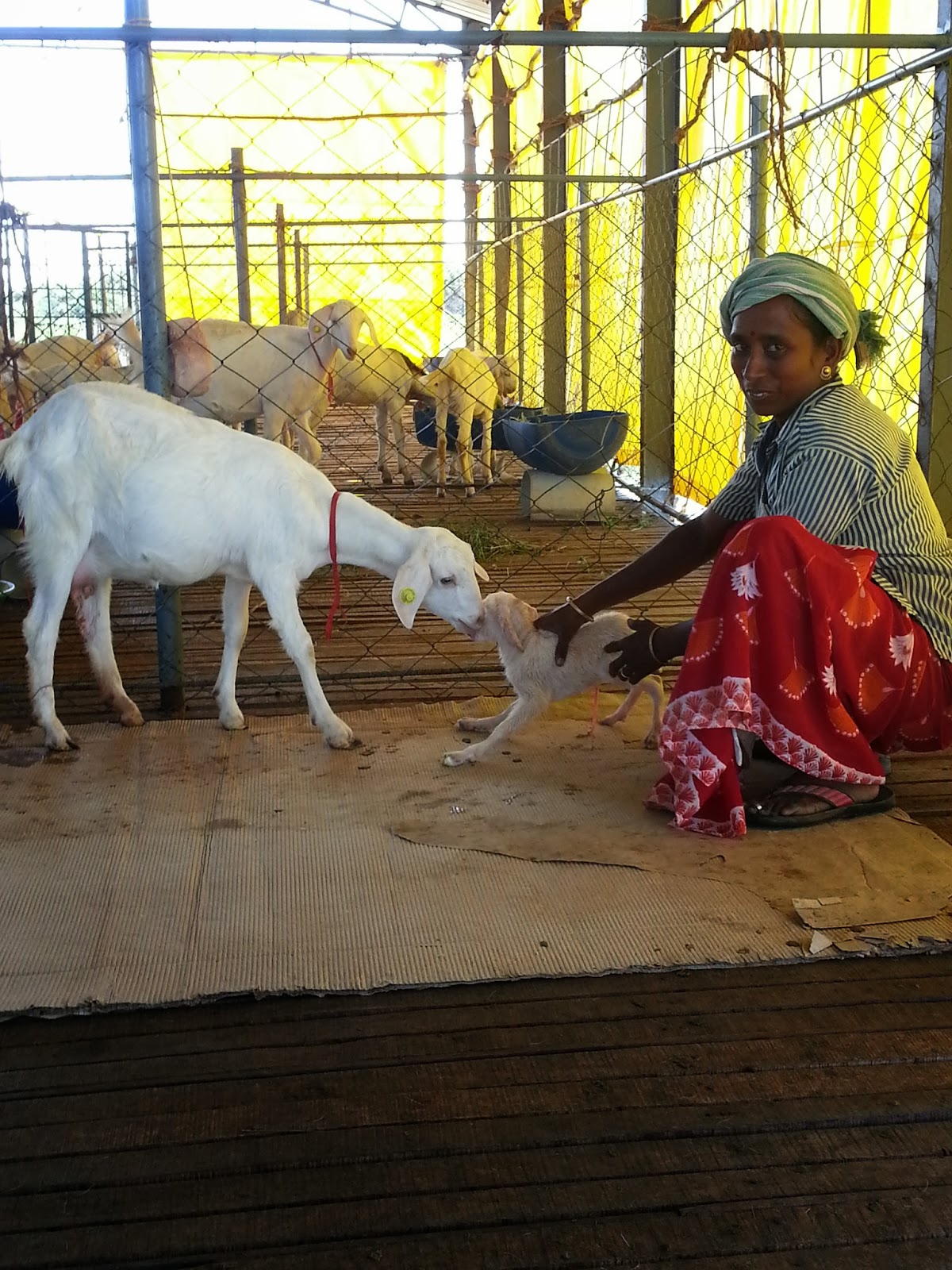
Some kids have to be guided initially before they identify with their mothers.

While other kids get to business right away. Feeding time!
Post delivery, kids need to be cleaned and inspected
Our first set of twins, hoping for several more!

In an hour or two, the newborns start to settle down and the does can become quite protective

Here are a couple of key metrics we found helpful :

Parameters
Range
Notes
Temperature
102.5 - 104
Depends on ambient temperature
Pulse rate
70 - 80
Beats per minute
Respiration
15 to 30
Per minute
Stomach movements
1 - 1.5
Per minute
Puberty
7 weeks - 8 months
Separate bucks from does at 2 month
Stomach movements
1 - 1.5
Per minute
Estrus/Heat Cycle
17 to 23
Days
Gestation
143 to 155
Days
Life span :


Does
11-12 years
Often death in does is kidding related
Bucks
8-10 years

Productive kidding
8-10 years
For Does
Full growth size
At 30-33 months
Most keep growing until year 3

With the kiddings steadily becoming the norm at Savera Farms, our foray into goat rearing is steadily moving to the next level. While we are encouraged the flock is increasing, it also comes with added awareness and responsibility. As we acquire experience and develop the needed skills, we constantly work with more experienced operations for advice and best practices. At the moment, we are trying to understand how larger herd operators manage simultaneous kidding of 200-250 does. Feel free to share your advice and readings.